

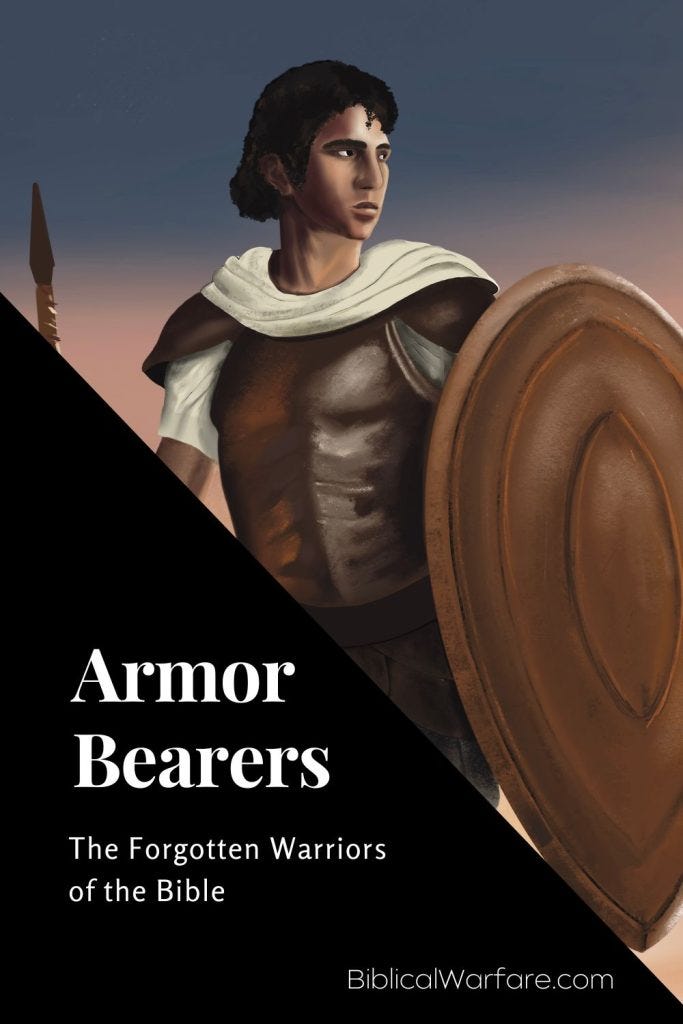
Do a Google search on armor bearers, and you will get a long list of articles and blogs that spiritualize the concept. Here, I take a different approach because I am more interested in the role that armor bearers played in ancient history and how that can help contextualize the role of armor bearers in the Bible. Doing so enhances our understanding of famous Bible stories, and it clarifies the relationship between key Bible figures, specifically David and Saul.
What Is an Armor Bearer? Untangling Ancient Terminology
When researching and writing, it is always helpful to define terms, and yet, being able to do so was the greatest challenge I faced. The phrases “armor bearer” and “shield bearer” are used inconsistently in ancient warfare literature. This inconsistency is not surprising, given that armor bearers (and shield bearers) served in military forces across many different cultures and historical periods. For example, the phrases “shield bearer” and “armor bearer” are often used interchangeably, and the roles of individuals who bore that name varied significantly from army to army and era to era. At times, a shield bearer could refer to an experienced warrior who attended a member of the elite. Other times, shield bearers operated as a unit providing a shield wall for the entire formation, like the Persian “Sparabara,” during the Achaemenid Empire1. Those are two very distinct roles, and it gives us two very different pictures of what a shield bearer meant for each army.
When looking at scripture, we are therefore left to use contextual clues to determine the true roles of armor bearers and shield bearers within specific militaries. Fortunately, in the biblical record, most mentions of armor bearers appear within the lifetimes of King David and King Saul. That allows us to narrow down the role of the armor bearer within Saul’s kingdom (and will also help us better understand David’s role as an armor bearer to Saul).
For the sake of this article, unless otherwise noted, I will use the terms armor bearer and shield bearer to reflect these differences in roles: armor bearers are personal military aides with broader responsibilities, while shield bearers have a more function-specific role, providing defensive support. However, keep in mind that overlap is common.
Before I dive into the biblical texts, I will first do a cursory review of how some ancient militaries used armor bearers and shield bearers.
Armor and Shield Bearers in the Armies of the Ancient World
The use of armor bearers and shield bearers (whether we are referring to a skilled fighter who carried the armor of an elite warrior, or a rank-and-file soldier who supported his unit by holding a shield) was the natural result of the evolution of ancient warfare and weaponry. While adopting armor and shields would better protect the individual fighter, it would also make fighting more cumbersome. No matter how good or strong a warrior was, the use of armor and a shield would impede his agility with a sword, a spear, a sling, or a bow. Incorporating armor bearers and/or shield bearers allowed warriors to fight unimpeded. It also allowed entire units to make better use of their armaments.
As discussed, ancient militaries used armor and shield bearers differently, and there was no consistency in how terms were used across nations and cultures. Neo-Assyrians, for example, had various Akkadian terms for shield bearers. These terms, literally translated as “the one with a shield,” “shield man,” and “shield-soldier,” seem to refer to a foot soldier who carried a shield along with another weapon. In essence, the basic infantryman. Three additional Akkadian terms also appear to designate types of shield bearers, but scholars have not been able to determine the precise distinctions between them. However, reliefs show that in the first millennium BCE, the Neo-Assyrians employed shield bearers in siege warfare to protect archers from defenders. Also, in chariot warfare, a “third charioteer” could serve as a shield bearer, protecting both the driver and the warrior.
Terms also changed in meaning over time within the same culture. For example, Herodotus uses the Greek word “hypaspist, literally meaning “shield bearer” to refer to an individual who attended to the Cypriot leader, Onesilus, against the Persians during the battle of Salamis (498 and 497 BC). In Herodotus 5.111, Onesilus and his “shield bearer” strategize on the best way to overtake the Persian satrap, Artybius. The “shield bearer” is described as “well skilled in war,” and Onsilus highly valued his opinion. Clearly, he was no ordinary soldier; he was an elite fighter, and a modern understanding of an armor bearer is probably a better-suited term for him as opposed to a shield bearer.2
The term “hypastis” would evolve to mean something different, however. By the time of Philip II (359-336 BCE) and Alexander the Great (336-323BCE), the word “hypaspist” had become synonymous with an elite unit. It no longer referred to an individual charge, serving an elite warrior, but rather a unit of elite warriors who had a distinct role in the Greek army.3 Despite the inconsistency in terminology, clearly, both armor bearers and shield bearers were used by ancient militaries.
In the biblical texts, we will find the same to be true. Although there are more references to armor bearers, the mention of a shield bearer appears in one of the most famous Bible stories. How the Neo-Assyrians employed their shield bearers in chariot teams might provide clarity to that biblical account. However, the biblical role of armor bearers parallels how the Cypriot leader Onesilus employed his “shield bearer.” With that said, let’s pivot and review the biblical texts.
Armor Bearers in the Biblical Record
There are four total references to armor bearers in the Bible. One of them is in the book of Judges, and the other three appear during the reigns of Saul and David. This group of three allows us to draw some conclusions on how armor bearers were employed during that era. There is only one mention of a shield bearer in the entire Bible. I have read the verse a few hundred times, and only while researching for this article did it dawn on me how he is hardly portrayed in images and artwork. If you are not already familiar with this shield bearer, I am sure I have now piqued your curiosity, so let’s look at each reference one by one.
Loyalty Unto Death: Abimelech’s Armor Bearer
A young man charged with the brutal task of killing his master, Abimelech, is the first mention of an armor bearer in the Bible. Abimelech was Gideon’s evil son who killed seventy of his brothers to cement power. In one of his military engagements to seize the city of Thebez, the city’s inhabitants had sought shelter in a tall tower. It was there that a woman took a millstone and dropped it on Abimelech, gravely injuring him. Afraid of dying at the hand of a woman, Abimelech asked his armor bearer to kill him with the sword. His charge faithfully obliged, ending Abimelech’s life.
In this biblical reference, the Hebrew words transliterated as kᵊlî (article or vessel) and nāśā (to carry or bear) are used to describe the young man’s role.
We have little information on the armor bearer’s abilities and the full extent of his responsibilities. Based on the literal translation of the Hebrew words used and the context, we know that at least he carried Abimelech’s excess weapons and/or armor. We also know that he was loyal, as he obediently obeyed Abimelech’s orders. You can read the account in Judges 9:22-57.
Heart and Soul: Jonathan and the Warrior Who Followed Him
An armor bearer who is bound to a master must follow his master’s whims, regardless of the danger or risk involved. One can only imagine what Jonathan’s armor bearer (in the Hebrew, kᵊlî nāśā) was thinking when Jonathan proposed that both of them attack a Philistine garrison without the knowledge and therefore the support of King Saul and his army. The attack was not meant to be a surprise, as I discuss in “Jonathan in the Bible: Humble Prince, Brave Warrior,” but by all calculations, it most certainly was perceived as a suicide mission. Loyal to his sire, the armor bearer responded with, “Do all that is in your heart. Do as you wish. Behold, I am with you heart and soul.” The armor bearer’s words echo Onesilus’, who told his master, “Both, my liege, or either, am I ready to undertake, and there is nothing that I will shrink from at thy bidding,” when his master asked him if he wanted to take down the horse or the rider. He was as loyal as Jonathan’s armor bearer.
Both Jonathan and the armor bearer revealed themselves to the Philistine outpost from a lower, visible position, such as the bottom of a cliff. When the Philistines saw Jonathan and his armor bearer, they summoned them up. After scaling the cliff or crag, both men reached the garrison. Upon reaching the top, both still managed to kill 20 Philistines, working symbiotically and rhythmically to subdue their enemies. Clearly, Jonathan was a skilled fighter, but his armor bearer was no pushover either.
Based on the various translations (see below) of 1 Samuel 14:13, the armor bearer either covered Jonathan’s rear, killing anyone approaching Jonathan from behind, or he finished off anyone Jonathan struck down. I am inclined to believe that it is the former, as it would have been more prudent for both to protect each other’s six. If it is indeed the former, we can conclude that the armor bearer was an elite warrior like his master, Jonathan.
“Jonathan climbed up using his hands and feet, with his armor-bearer behind him. Jonathan cut them down, and his armor-bearer followed and finished them off.” CSB
“So they climbed up using both hands and feet, and the Philistines fell before Jonathan, and his armorbearer killed those who came behind them.” NLT
“Then Jonathan climbed up on his hands and feet, and his armor-bearer after him. And they fell before Jonathan, and his armor-bearer killed them after him.” ESV
Read the full account in 1 Samuel 14:13.
In the Service of the King: Saul’s Armor Bearers
Only two chapters after Jonathan’s victory at the Philippine garrison, we learn that King Saul made David his armor bearer (in the Hebrew, kᵊlî nāśā). Why did he do so? After an evil spirit had tormented Saul, his servants suggested that he find someone who could play the lyre for his well-being. When Saul agreed, one of the servants suggested that he employ David. According to the servant, in addition to his reputation as a skilled musician, David was also known for being “a man of valor, a man of war.”
Seeing David’s reputation as a warrior, it would have been only natural for Saul to make him both an armor-bearer and his musician. Having fighting experience as a precondition for becoming an armor bearer aligns with the role Jonathan’s armor bearer had. (See 1 Samuel 1:17-23)
David was not Saul’s only armor bearer. Later in his reign,1 Samuel 31 and I Chronicles 10:1-14 detail the last confrontation between King Saul and the Philistines. It is the battle where Saul and three of his sons, including Jonathan, lose their lives. Archers strike Saul and gravely wound him, and he pleads for his armor bearer (in the Hebrew, kᵊlî nāśā) to strike him down before the Philistines could get to him and do worse. The armor bearer refuses because he was afraid, probably of killing the king. Saul therefore fell on his own sword, and the armor bearer did the same shortly after.
There is no description of the fighting abilities of this armor bearer, but loyalty is clearly a common theme. The armor bearer could have tried to save himself, but instead chose to share the same fate as his master.
Among the Mighty: Joab’s Armor Bearer
The last armor bearer mentioned in the Bible is Naharai of Beeroth, Joab’s armor bearer (in the Hebrew, kᵊlî nāśā). His name appears among the elite warriors who served King David, known as David’s mighty men, and/or “The Thirty.” While there is no other description of Naharai’s prowess, none is needed to ascertain his level of skill. Only David’s top men, such as Benaiah and Abishai, known for amazing feats in battle, are mentioned among “The Thirty.”
His inclusion in “The Thirty” confirms that Joab’s armor bearer was among the best there was in the entire kingdom.
The Forgotten Figure in the Valley of Elah: Goliath’s Shield Bearer
In the David and Goliath story, David is often portrayed as a boy who defeats a giant. There are two inaccuracies with that portrayal. I discuss the first in detail in “King David, The Warrior King.” David was not a boy; he was likely a young man in his early twenties. The second inaccuracy is the omission of Goliath’s shield bearer, clearly mentioned in I Samuel 17:7.
The Hebrew terms kᵊlî nāśā do not appear in verse 7; rather, ṣinnâ is paired with nāśā. The former is the Hebrew word for shield, and hence the use of “shield bearer” in most Bible translations. While some literature may use armor bearer and shield bearer interchangeably, there is reason to believe that the role of Goliath’s “shield bearer” was different than Jonathan’s armor bearer, for example.
The Philistines, as confirmed in Biblical texts, used chariots in warfare, and the description of Goliath’s armor lends credence to the idea that Goliath was indeed an elite charioteer. For an in-depth discussion on the evidence for this claim, see Jefffrey Zorn’s paper, “Reconsidering Goliath: An Iron Age I Philistine Chariot Warrior.4 His hypothesis is supported by I Samuel 17:4, where Goliath is described as a “champion.” The Hebrew word translated as champion is transliterated as bēnayim, and it literally means, “man of the space between.” In descriptions of chariot warfare of the Neo-Assyrians, for example, chariots were composed of three-man teams, where the position of the third man would be between the other two.
Shield bearers were also common “accessories” on a chariot team. The shield barrier would protect the driver and the other warrior. His role, therefore, would have been different than the armor bearers that Jonathan and Saul would have used. Their armor bearers would be called upon to actively fight alongside their lord or master, while a shield bearer, as the one Goliath had, would have had less of a fighting role.
The shield bearer likely stepped aside when David engaged Goliath to make it a “fair” fight. His initial role in verse 7 was more likely to protect Goliath from stray arrows and preserve the giant for the one-to-one duel. In the end, the use of the sling by a much smaller opponent was the giant’s ultimate undoing.
What This Means for David: Warrior, Armor Bearer, and Servant of Saul
The primary lesson from studying biblical armor bearers is the profound revelation it provides about David’s own role as an armor bearer and, hence, his relationship with Saul. The armor bearers used in Saul’s and David’s kingdoms were elite warriors, loyal to their sires. They may have carried armor and other weapons, but they were reliable fighters in their own right. We must therefore conclude that for Saul to choose David as his armor bearer, he must have been a proven fighter.
If Jonathan, a prince, and Joab, a general, had exceptional, proven warriors to assist them on the battlefield, it is only logical to conclude that King Saul would have had at least the same, if not better. The servant’s description of David “as a man of valor, a man of war,” only confirms my hypothesis. It would be illogical for Saul to choose an inexperienced shepherd boy for that role. He might not have been as elite as the men of “The Thirty” at that point, but he was not merely a shepherd boy either.
In addition, as Saul’s armor bearer, he would have been engaged in additional training. Even if he never joined Saul on the battlefield, he would have trained alongside his master, who was an experienced warrior. This, of course, calls into question the chronology of Chapters 16 and 17 of I Samuel. In Chapter 16, David is employed as a musician and an armor bearer. In Chapter 17, David kills Goliath, and then in Chapter 18, Saul does not seem to have any idea who he is. That would be unlikely if David did serve as his armor bearer. So either King Saul was mentally unwell and couldn’t remember (a possibility due to the demon tormenting him in I Samuel 16:14) or David became an armor bearer after he killed Goliath. Personally, I think David was an armor bearer before Goliath.
From I Samuel 17:15, we know that David traveled back and forth from Saul to attend to his sheep in Bethlehem. David engaged Goliath upon his return from Bethlehem. But I Samuel 18:2 states that right after he defeated Goliath, Saul did not allow David to return home. If Saul was employed as a musician and armor bearer afterwards, it would render I Samuel 17:15 untrue. What I believe is happening here is that David was not Saul’s full-time armor bearer. He may have been one of several serving in that role or possibly an armor bearer in training. However, his victory over Goliath would cement his reputation among the military, which is why Saul could place him in command of large units of men (see I Samuel 18:5).
If the chronology is correct, David was not a young, inexperienced boy when he faced Goliath. He was already a trained fighter, lethal with a sling (an often-used weapon of war). If Saul’s armor didn’t fit him, it was probably because Saul was exceptionally tall (see I Samuel 9:2). That does not take away from David’s accomplishment nor his faith. Goliath was not only a giant, but his experience would have been superior to David’s, and he was armored. David slaying Goliath was less of a miracle and more of God placing a skilled warrior with unshakable faith in the path of a terrifying opponent. In King David: Rise of the Warrior King, I portray it as “a Marine private volunteering to fight against a giant while Navy Seals were too scared to do so.”
Before the Crown: David the Armor Bearer
The armor bearers in the Bible played heroic roles. They were loyal, skilled, and essential warriors during Israel’s rise as a kingdom. In Scripture, they are mentioned only in connection with high-ranking officials, princes, or kings, suggesting that armor bearers were likely a privilege of the elite, much like in other ancient armies.
The most famous armor bearer in the Bible is David, yet he is rarely portrayed that way. But David truly was an armor bearer, and likely a very good one. It would have been a natural proving ground for the man who would later become one of Scripture’s greatest warriors and military commanders. Artwork of David with a sling will always have its place. But perhaps it is time to remember that before David was a giant-slayer and king, he was an armor bearer.
“Sparabara: shield bearers of the Achaemenid Persian Empire, June 1, 2024, https://www.historiascripta.org/classical-antiquity/sparabara-shield-bearers-of-the-achaemenid-persian-empire/
Herodotus 5.111, https://files.romanroadsstatic.com/materials/herodotus.pdf
see https://www.worldhistory.org/Hypaspist/ and https://alexander-the-great.org/warfare/hypaspists
Jefffrey Zorn, “Reconsidering Goliath: An Iron Age I Philistine Chariot Warrior,” https://www.scribd.com/document/336706876/Philistine-Chariot-Warrior-Reconsidering-Goliath-pdf
The post Armor Bearers: The Forgotten Warriors of the Bible appeared first on Biblical Warfare.