

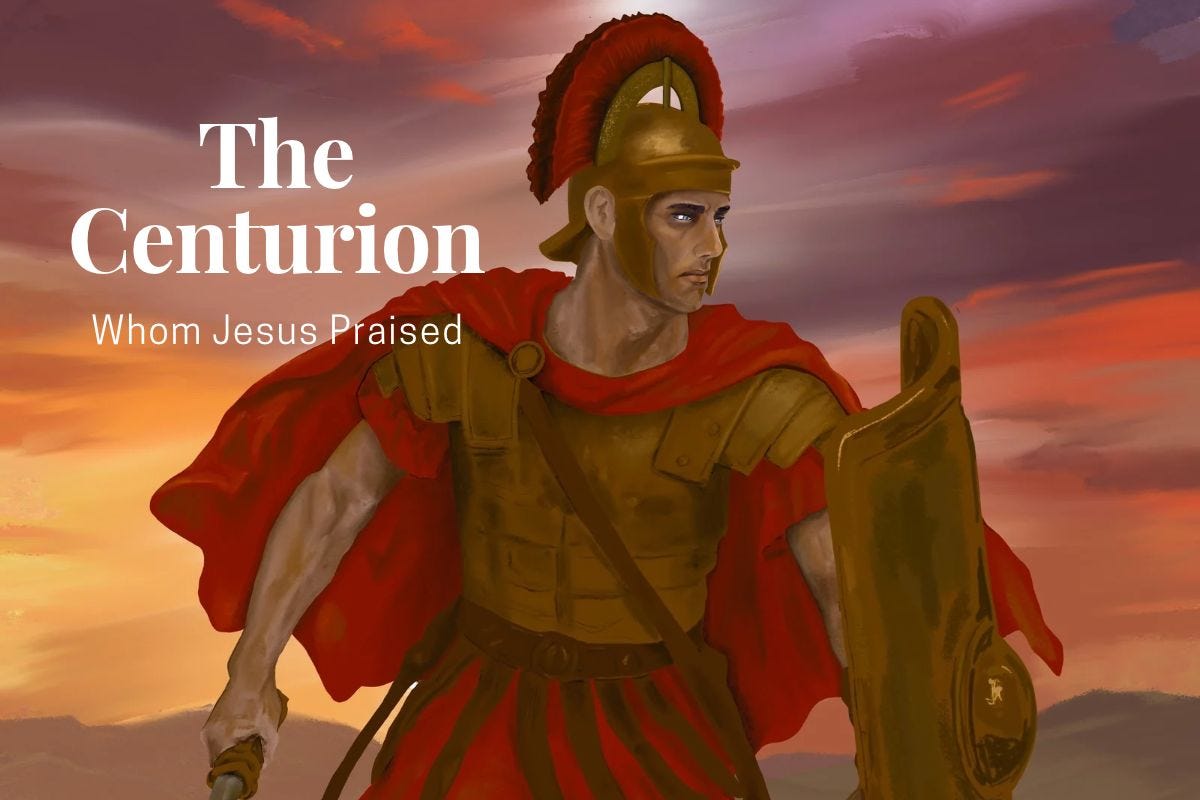
The Centurion at Capernaum
You are a Centurion in Capernaum in the 1st century AD, and your beloved servant becomes paralyzed. You hear of the Jewish messiah and his healing powers and decide to ask him for a favor. He offers to come with you to heal him, but you understand something few others do. Authority. If He already has authority in the spiritual realm to heal, He need not be present to do so. His word alone is enough, because your word is enough.
This Messiah marvels at your faith, which might leave you a little confused because for you, it isn’t faith, or at least not faith as the rest of the world sees it. For you, the certainty behind authority in military structure is ingrained in every fabric of your being. But for the Messiah, it becomes a perfect opportunity to teach his disciples about the practical expression of faith.
Comparing the Biblical Accounts
The story of the centurion and his faith appears in both Matthew and Luke:
Matthew 8:5-13: The centurion approaches Jesus directly in Capernaum and asks him to heal his servant. Jesus offers to go with him, but the centurion bids him not to. He feels unworthy and doesn’t believe Jesus’ presence is necessary because His word alone is enough, just as a military officer’s command is obeyed without question.
Luke 7:1-10: The centurion does not approach Jesus directly but sends Jewish elders instead. Yet through them, he relays the same message about the role of authority. In this account, we learn the centurion loved the Jewish people and had financed the construction of a synagogue.
A similar story appears in John 4:46-54 where an “official” in Capernaum requests healing for his son (instead of a servant). However, in John’s account, there is no apparent exchange between the official and Jesus about the role military authority plays in faith.
Re-Examining the Roman Identity
Was He Really a Roman Soldier?
Most readers, and even Bible teachers and pastors, automatically assume that the official who approached Jesus is a Roman centurion. However, many biblical scholars question this assumption because of the lack of historical evidence supporting Roman presence in Capernaum at that time. The first long-term Roman garrison was not established in Galilee, where Capernaum is located, until 120 CE (see Greco-Roman Culture and the Galilee of Jesus).
These scholars often cite language choices in the original Greek as further evidence. The use of the more generic Greek term ἑκατόνταρχος for “centurion” in both the Matthew and Luke accounts lends credence to this theory.
The term ἑκατόνταρχος means commander of a hundred. Compare that to the word κεντουρίων, which is the Greek transliteration of the Latin word centurion, used to describe the Roman centurion at Jesus’ crucifixion in Mark 15:39-45. By using a transliteration of the actual title, instead of a generic term, along with the historical presence of Roman soldiers in Jerusalem, it leaves the reader without a doubt that the soldier at the crucifixion was indeed Roman. But by using a generic term in Matthew and Luke, the author leaves it open to the possibility that the centurion in those accounts may not have been Roman at all.
Who Was the Officer Serving?
If the centurion whom Jesus praised was not from the Roman legions, then who was he?
Galilee, at the time, fell under the jurisdiction of Herod Antipas, who governed as a tetrarch, client-ruler of Rome. As a client ruler, he maintained substantial autonomy over his region, and scholars assess that he had his own military forces for internal security. That assessment is based on the following:
Roman Policy: Rome preferred that its client rulers provide their own security for internal affairs.
Herodian Precedent: Antipas’ father, Herod the Great, and former client-king of Galilee and the surrounding region, maintained his own military. When Herod died, his realm was divided among three of his sons. Scholars therefore assume that because Herod the Great managed a substantial military, each son, including Antipas, would have also inherited control of the military forces in their respective regions. (See Client Kings’ Armies Under Augustus: the Case of Herod by Denis B. Saddington).
Historical Records: The Jewish historian Josephus relates Antipas raising an army when he went to war against Aretas IV (See The Works of Josephus, translated by William Whiston, Josephus, The Antiquities of the Jews, Book 18, Chapter 5, Section 1, Page 484, Hendrickson Publishers, Inc., June 2000).
Based on this evidence, the simplest explanation is that the “centurion” was an officer in Antipas’s military forces holding a rank equivalent to a Roman centurion.
The wealth of the officer implied in the Luke account also supports this hypothesis. Only a man of significant means could patron a Jewish synagogue. A high-ranking military officer from Antipas forces could have had that kind of wealth. That same account identifies the officer as a Gentile, when the elders told Jesus, “he loves our nation.” (Luke 7:5). Since Herodian rulers routinely hired foreign mercenaries, this also explains why a non-Jewish Gentile was serving in Galilee and loved by local Jewish elders.
The Case for A Roman Legionary
Administrative Skills and Retiree Wealth
While a Herodian officer is the simplest explanation, we cannot completely dismiss the possibility that he was an authentic Roman centurion.
In the Roman legions, centurions were not only capable warriors, but also proficient administrators. Because the Roman military had an expansive engineering mandate to construct roads, bridges, towers, siege works, and other types of infrastructure, centurions gained experience supervising construction projects, organizing labor, and coordinating schedules (See The Forgotten Soldiers of the Roman Empire).
Centurions also developed accounting skills by supervising the distribution of pay and deductions for food/equipment, for example, and at times, even overseeing the collection of tax revenues. Higher-ranking centurions would have a voice on matters pertaining to legionary administration, logistics, and strategy. This experience made centurions highly capable administrators with valuable skills. Therefore, with their combination of leadership and logistical expertise, Roman centurions who survived to tell their tale and completed their service to the legions became prime candidates for lucrative administrative positions across the Empire.
Given that Antipas’ father, Herod the Great, had a close relationship with the Emperor Augustus, and had at times used Roman advisors to help establish his own military forces (See The Rise of Herod the Great), it is possible that Antipas might have followed suit and employed a Roman centurion to suit his needs. Antipas inherited Galilee, and his forces were well established and less likely to need help from Rome, but it is not unforeseeable that a Roman centurion could have taken up a position within Antipas government and/or military. We already know from the Gospel accounts that the officer was indeed a Gentile, therefore confirming his non-Jewish heritage.
Financial Evidence
Centurions who rose in the ranks, and especially those who took administrative positions post-service, could accumulate substantial wealth.
Even a new centurion earned significantly more than a legionary. While the common soldier received 225 denarii a year, the lowest-ranking centurions would earn 16 times more—that is approximately 3750 denarii a year. A primus pilus, the highest-ranking centurion in a legion, earned 60 times more with 15,000 denarii a year. Those who retired would collect a 150,000 denarii payout. (See Roman Soldier’s Pay)
How much wealth is that?
Although the purchasing power of one denarius varied over time because of inflation, scholars agree that one denarius was equivalent to about a day’s wage for a laborer. If a day’s wage today is roughly $50, then a retired centurion would earn a payout of approximately $750,000 (see What a denarius worth in Jesus’ day?). That payout is in addition to whatever he had earned and invested during his time in the legions. If a centurion took on an administrative position across the Empire, he would continue to make lucrative gains. A Roman centurion could therefore certainly afford to finance a construction project in Galilee such as a synagogue as quoted in Luke 7:5.
Biblical Use of Language
While it is true that the generic term ἑκατόνταρχος is used in the Matthew and Luke accounts to refer to this official, it is not exclusively used to refer to non-Romans. In the book of Acts, that same generic term for commander is used to refer to Roman centurions, including these two examples:
Acts 10:1 (ESV): Caesarea there was a man named Cornelius, a centurion of what was known as the Italian Cohort,
Acts 22:25 (ESV): But when they had stretched him out for the whips, Paul said to the centurion who was standing by, “Is it lawful for you to flog a man who is a Roman citizen and uncondemned?”
Therefore, the generic term does not automatically disqualify the official from being a Roman centurion in the Matthew and Luke accounts.
Why the Military Context Matters
The Rigor of Ancient Discipline
Does it matter that the individual was a centurion or not? In the overarching narrative, it does not. The primary message relayed through the story is still one of faith. However, if he was indeed a Roman centurion, that lesson of faith carries more weight.
Any veteran or person familiar with military operations can relate to the words the official spoke to Jesus. In any military, whether ancient or modern, respecting authority is crucial for the war machine to rage forward. Any subversion of that authority can lead to disaster in military operations at the tactical, operational, and/or strategic level. Therefore, militaries, by necessity, train their men to follow orders.
In modern warfare, with the evolution of human rights, questioning authority has become more common than it would have ever been in ancient warfare. But even compared to ancient militaries, Roman legionaries stood out for their discipline and adherence to orders. That is not to say that mutiny never happened. It did, but Rome’s reputation for its rigidity in the ancient world is well documented.
In the rigid Roman military structure, centurions were the backbone of legionary discipline.
To the legionaries, centurions were often god-like. They were leaders required to lead from the front. When their men bled, they bled, earning a respect only earned on the battlefield. A centurion who rose in rank continually demonstrated his courage, surviving the cruelty of war over and over again.
But centurions were also disciplinarians. They carried a vitis, a vine staff (a knotted cane made of grape vine) often used to discipline on the spot for infractions such as lateness or sloppiness. Other forms of discipline included the docking of pay, public humiliation, assigning extra and humiliating chores such as cleaning latrines, and ration reductions.
Within the Roman military machine, the threat of decimation also helped keep troops in line. It was an extreme form of discipline—a collective punishment of an entire cohort (appx 500 men) for capital crimes such as cowardice, desertion, or mutiny. The cohort would be divided into groups of ten, and then each group would draw lots. One individual from each group would be slated for execution, but the punishment had to be carried out by the other 9 men via bludgeoning or flogging.
Although rarely put into practice, the threat of it was enough to keep legionaries from subverting authority.
The bottom line? Legionaries did not question orders from their centurion. To quote the official and possible centurion in Luke 7:8:
“I say to one, ‘Go,’ and he goes; and to another, ‘Come,’ and he comes; and to my servant, ‘Do this,’ and he does it.”
Authority as the True Expression of Faith
The official who approached Jesus understood a simple truth: Jesus held supreme authority over the spiritual and physical realms.
In his disciplined mind, if Jesus possessed authority, then whatever He commanded, even the healing of a distant servant, would be carried out.
For a civilian mindset, that idea may not be understood as easily because in the civilian world, authority does not automatically equal action. At times, it can, but authorities are not as rigidly followed or obeyed. For the military mind, especially if he was indeed a Roman centurion, authority and execution are synonymous.
The official’s faith was not centered on whether Jesus had the ability to perform a miracle, but on the conviction that He held the authority to issue the order. Because if he had the authority, the outcome was a foregone conclusion.
And that is why Jesus marveled. While others were looking for a miracle worker, the centurion recognized the Sovereign. He didn’t just see a healer; he saw the Commander of heaven and earth, and whatever he ordered, it had already been accomplished.
I am not only a writer, but also an artist. And for every article on Biblical Warfare, I draw my artwork. The Faith of the Centurion is now available as a poster on my Etsy store.
